Click to navigate:
- More Than Half of Homeowners Carry Credit Card Debt
- Homeowners Remain Deeply Committed to Homeownership
- Credit Card Debt Is Forcing Homeowners To Make Tradeoffs
- Many Homeowners Are Looking for a New Path Forward
- What To Consider When Evaluating Debt Options
- The Bottom Line
More Than Half of Homeowners Carry Credit Card Debt
Credit cards can be a useful financial tool, helping consumers manage expenses, cover unexpected costs and earn rewards. But if you carry a balance, you’ll typically be charged interest on that amount. 51% of surveyed homeowners report carrying a credit card balance from one month to the next.
Many of These Homeowners Say Their Situation Has Worsened
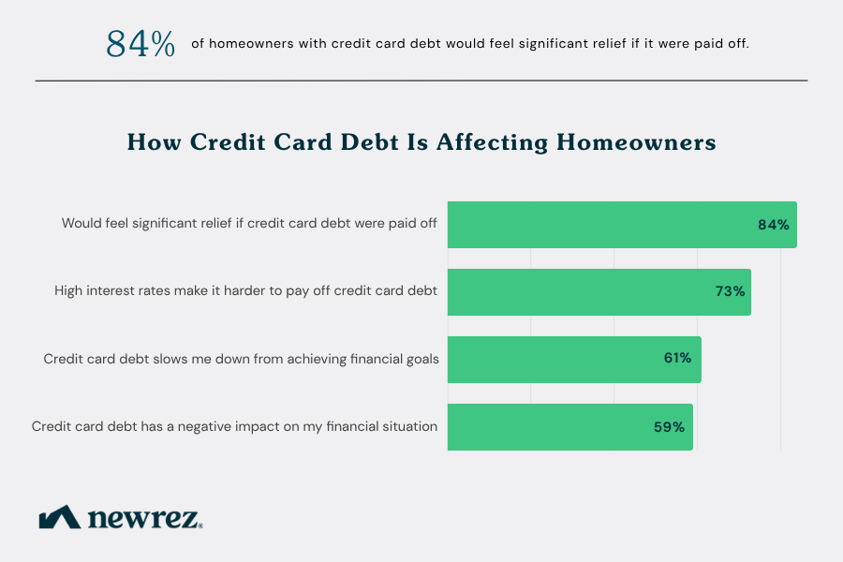
Carrying a balance can be hard on homeowners. 84% of surveyed homeowners with credit card debt would feel significant relief if credit card debt were paid off. 61% say it’s slowing progress toward their financial goals, and 59% say it has a negative impact on their financial situation.
Many homeowners carrying this debt report stress related to their financial situation. More than two-thirds (67%) feel overwhelmed by their finances at least sometimes, more than half (51%) say they’re losing sleep over finances and less than half (48%) feel that they’re in control of their finances most or all of the time.
They’re finding it difficult to pay off the debt. 61% of surveyed homeowners with credit card debt say their balances increased over the past year. Interest rates on credit cards may be nearly 20% or higher, making it difficult for many homeowners to pay down their balances1. 73% of these homeowners say high interest rates make it harder to pay down what they owe.
Homeowners Remain Deeply Committed to Homeownership
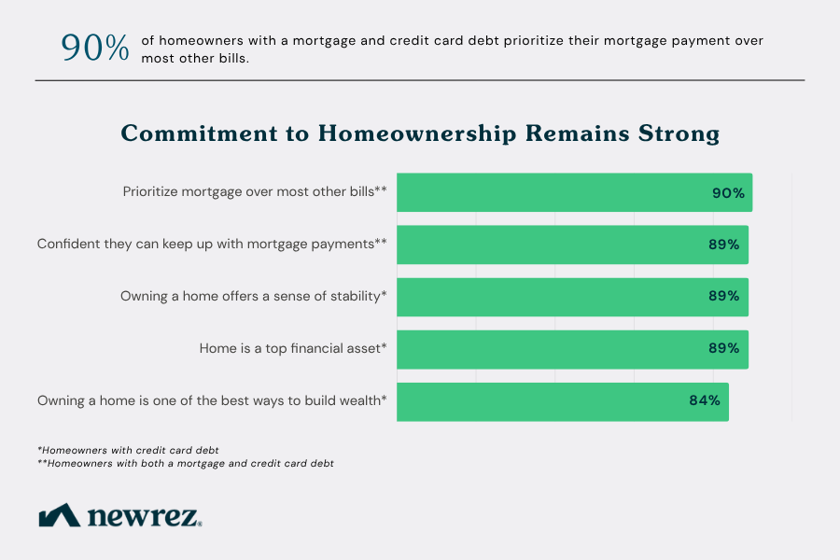
Despite the financial challenges many homeowners with credit card debt face, their commitment to homeownership remains remarkably strong.
For many homeowners with credit card debt, a home provides more than just a place to live. Nearly nine in 10 (89%) say owning a home gives them a sense of stability, and the same percentage consider their home one of their most important financial assets. Most of these homeowners also continue to see homeownership as an important wealth-building tool, with 84% saying it’s one of the best ways to build long-term wealth.
Despite these financial challenges, nearly nine in 10 homeowners with credit card debt (88%) say they would choose to become homeowners again. Despite these pressures, homeowners continue to place significant value on owning a home and the financial opportunities it can provide.
Credit Card Debt Is Forcing Homeowners to Make Tradeoffs
71% of homeowners with credit card debt reported cutting back in at least one area because of that debt.
Although the biggest cutback homeowners with credit card debt have made is travel, leisure or discretionary spending, many of them have also been forced to cut back on everyday spending or necessities. Over a third of these homeowners have had to cut back on everyday expenses like groceries, a third have cut back on home maintenance or improvements and over one in five have cut back on medical or dental spending.
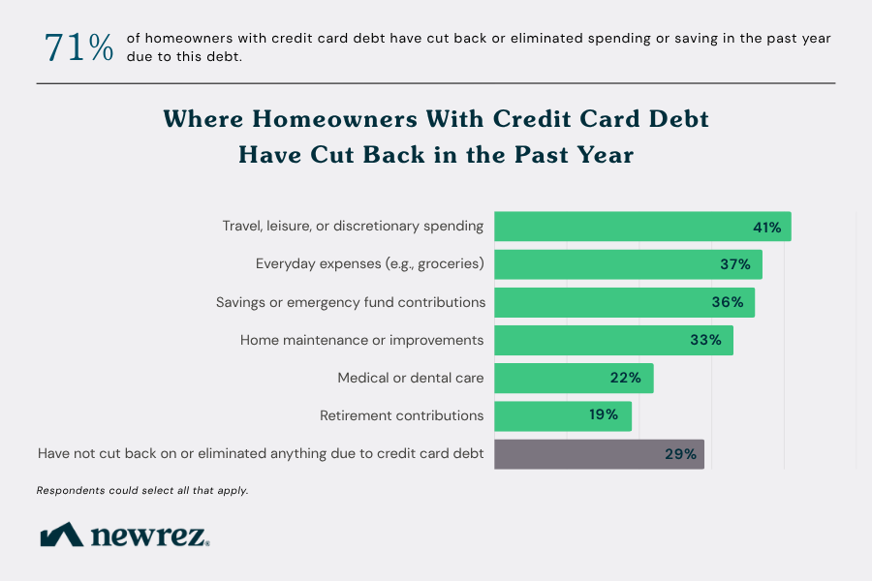
Long-term financial priorities are also being affected. More than a third of surveyed homeowners with credit card debt cut back on savings or emergency fund contributions, and 19% reduced retirement contributions.
Many Homeowners Are Looking for a New Path Forward
As credit card balances grow and interest charges make repayment more difficult, many homeowners with credit card debt are exploring ways to regain control of their finances. More than half (52%) say they researched debt consolidation options during the past year, while many are considering additional strategies that could help them pay down debt more efficiently.
Some of these homeowners are looking at ways to leverage the equity they've built in their homes, with 42% considering using home equity to pay off credit card debt faster. Others are exploring personal loans. Over half (57%) believe a personal loan could improve their current financial situation.
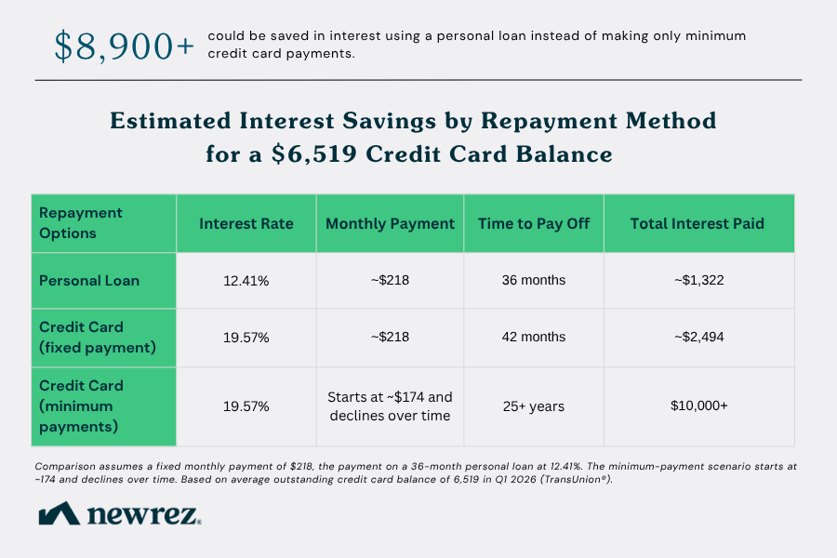
Debt consolidation may help homeowners reduce both interest costs and repayment time. As of July 1, 2026, the average interest rate for a 3-year personal loan was 12.41%2, while the average interest rate for a credit card was 19.57%1.
If the average credit card balance of $6,5193 was consolidated into a 3-year personal loan, the borrower would pay roughly $218 a month. By comparison, making the same monthly payment on a credit card with the average rate would cost the borrower nearly $1200 more in interest, and take an additional six months to pay off.
Someone making only minimum payments on a credit card balance of that size could take over 25 years to pay off the debt and wind up paying over $10,000 in total interest charges.
The Most Valued Potential Benefits of Debt Consolidation
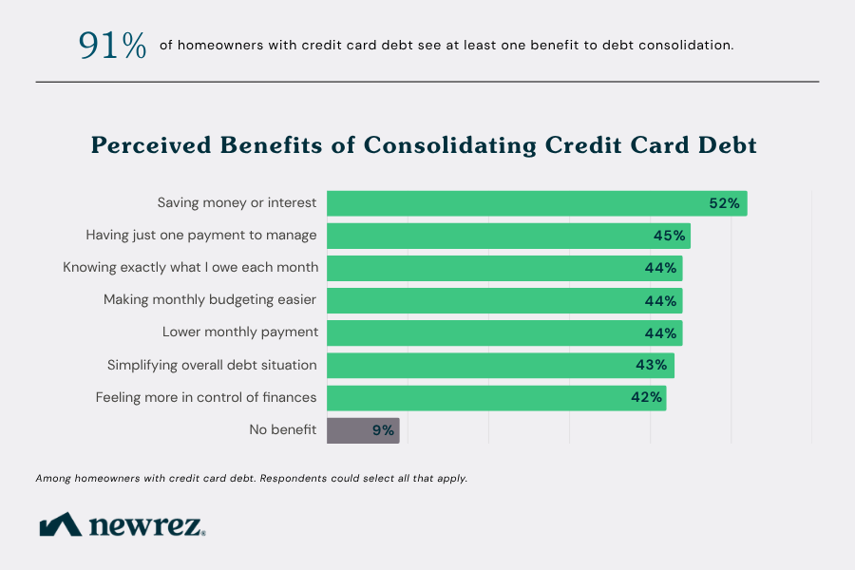
When asked what makes debt consolidation appealing, homeowners carrying credit card debt point to a mix of financial advantages and psychological relief. The biggest perceived benefit is saving money on interest.
The second most cited benefit is just having one payment to manage – that means not juggling multiple due dates or multiple minimum payments.
What To Consider When Evaluating Debt Options
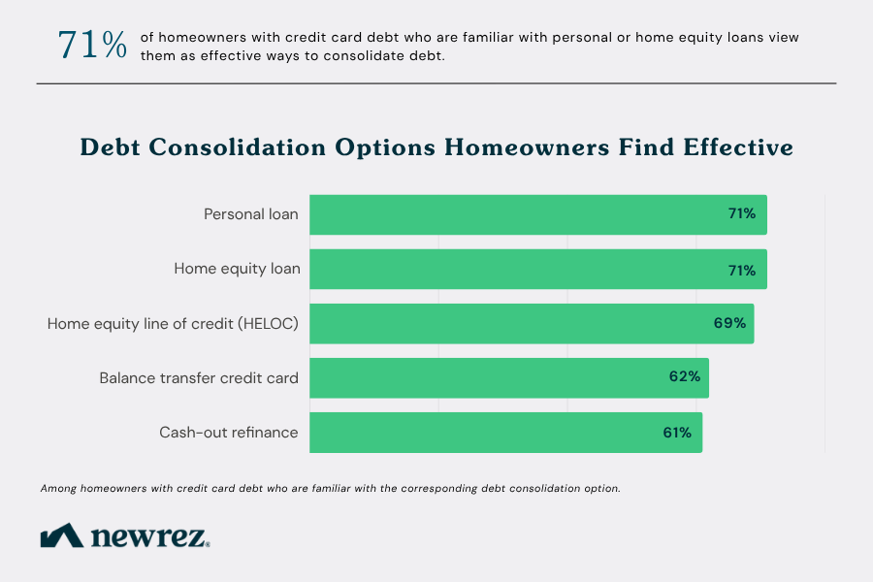
Homeowners with credit card debt who were familiar with the debt consolidation products listed in the chart below viewed personal loans and home equity loans as the most effective options. That was closely followed by home equity lines of credit (HELOCs), balance transfer credit cards and finally cash-out refinance. However, the right option for you depends on your situation.
What Debt Consolidation Options Might Work for You?
- Personal loan: A personal loan is an unsecured debt consolidation loan, meaning it is not backed by collateral. This option could be a good fit for homeowners who want to protect their property from risk, prefer fixed repayment terms and want a predictable, unvarying monthly payment. Because it does not require a property appraisal or a drawn-out underwriting process, a personal loan might be the fastest route to consolidation. However, because it is unsecured, and therefore riskier to the lender, the interest rate you are offered may be higher than it would be for a secured loan.4 You should also check and see if there are any fees that you’ll need to pay, like an origination fee.5
- HELOC (Home Equity Line of Credit)*: A HELOC is a secured, revolving line of credit backed by the equity in your home. It functions similarly to a credit card but typically offers a lower interest rate because the property serves as collateral. This may be a good option for homeowners who need flexible, ongoing access to funds over a draw period (often 10 years) rather than a single lump sum. HELOCs usually feature variable interest rates, meaning the monthly payment can fluctuate over time. More importantly, failure to repay a HELOC can result in the loss of the home.
- Balance transfer card: A balance transfer credit card allows you to move existing credit card balances to a new card, often with a promotional introductory interest rate that may be significantly lower than the rate on your current cards. This option may work well for homeowners who can qualify for these cards and pay down their debt during the promotional period. However, balance transfers often come with fees,6 and once the introductory period ends, the remaining balance may be subject to a much higher interest rate.7 For homeowners with large balances or who need several years to pay off debt, a balance transfer card may only provide temporary relief without a long-term repayment plan in place.
- Home equity loan**: Often referred to as a second mortgage, a home equity loan allows you to tap into your property's equity to receive a single, lump-sum payout. This can be helpful for homeowners who need a large, specific amount of money to pay off credit card balances and prefer a fixed interest rate and fixed monthly payment. Like a HELOC, this is a secured loan that uses the home as collateral, presenting a foreclosure risk if you default.
- Cash-out refinance***: This strategy involves replacing your existing primary mortgage with a completely new mortgage for an amount larger than what you currently owe, taking the difference in cash. This might work well for homeowners who can secure a new mortgage rate that is lower than their current rate, or those who need to consolidate massive amounts of debt over a long period (e.g., 30 years). However, if you currently have a low interest rate, a cash-out refinance might not be the best option, as it resets the interest rate on the entire balance of the home, not just the consolidated debt.
Factors to Consider When Consolidating Debt
Debt consolidation can make debt easier to manage, but it's important to make a well-informed decision. Before taking out a new loan or credit card, compare interest rates, fees, repayment terms and any risks associated with the product you're considering.
Keep in mind that a lower payment might actually be more expensive in the long term. If repayment is spread over a much longer period, you could end up paying more in total interest over the life of the loan.
Before consolidating debt, take time to review your budget and spending habits. Consolidation can provide breathing room, but it won't address the underlying causes of debt. Creating a realistic budget, building an emergency savings fund and avoiding new credit card balances can help prevent debt from accumulating again after consolidation.
The Bottom Line
Credit card debt is creating real financial challenges for many homeowners, affecting everything from day-to-day spending decisions to long-term financial planning. Yet despite these pressures, homeowners remain overwhelmingly committed to homeownership and confident in their ability to keep their homes.
If you're looking to improve your financial situation, there is no one-size-fits-all solution. Personal loans, balance transfer cards, home equity products and other debt-management strategies each offer potential benefits and tradeoffs. Taking time to understand the full costs, risks and repayment requirements of each option can help you make an informed decision and develop a plan that supports both your immediate financial needs and long-term goals.
Methodology
This survey was conducted by Morning Consult® on behalf of Newrez. It was conducted online among 2,203 U.S. adults from June 12–14, 2026. The sample is representative of the U.S. general population and includes segments by homeowner status and credit card debt status, including 486 homeowners who carry a credit card balance from month to month. Results for the total sample have a margin of error of ± 2 percentage points.